Your Website Isn’t Dead. Your Confusing Website Is.
The 5-step funnel strategy that turns ad clicks into customers instead of expensive “nice website†compliments
There is a cruel little joke in digital marketing:
You spend ₹2 lakh building a beautiful website.
Then spend ₹50,000 on ads.
Then celebrate because 3,000 people visited.
Then check sales.
Silence.
Your website looks fantastic.
Your designer is happy.
Your developer is happy.
Your hosting company is definitely happy.
Your bank account?
Not so much.
This is why the old-school idea of “send everyone to the homepage†is losing relevance in performance marketing.
ClickFunnels has been aggressively pushing this argument for years, even calling traditional websites “dead†for sales-focused businesses. Their more nuanced point is important: a website and a sales funnel serve different purposes. A website provides exploration. A funnel is designed around a specific conversion goal.
And in 2026, the argument becomes even more interesting because AI is changing how people discover products before they ever reach your website.
Shopify reports that AI-referred sessions to Shopify stores grew more than eightfold year over year in Q1 2026, while AI-referred visitors arriving on product pages converted at nearly 50% higher rates than organic search visitors.
The lesson?
The destination matters almost as much as the ad.

The Big Shift: Stop Building Websites. Start Building Buying Journeys.
Think about an Indian shopping mall.
You enter looking for running shoes.
Someone grabs your hand and says:
“Welcome! Here are shoes. Also shirts. Also watches. Also perfumes. Also our loyalty programme. Also today’s restaurant offers. Also here’s our furniture section.â€
You came for shoes.
Now you’re standing near a pressure cooker wondering how your life reached this point.
That is what many websites do.
Navigation menu.
Home.
About Us.
Blog.
Products.
Categories.
Offers.
Contact.
Newsletter.
Instagram.
YouTube.
“Download our app.â€
“Join our community.â€
“Read our latest article.â€
And somewhere between all those buttons, the customer quietly whispers:
“Bhai, mujhe kya karna hai?â€
A funnel fixes this.
A funnel says:
You clicked this ad because you wanted THIS.
Here is THIS.
Here is why THIS matters.
Here is the proof.
Here is the offer.
Click here.
That is the difference between navigation and conversion.

1. “The Website Is Dead†Is Provocative. The Real Idea Is Better.
Let’s correct the headline.
Your website isn’t dead.
Your website-as-a-paid-ad-destination strategy might be.
Your website still matters for:
- Brand credibility
- SEO
- Organic traffic
- Product discovery
- Customer support
- Trust
- Content marketing
- Repeat customers
- AI search visibility
But sending cold paid traffic to a homepage and expecting visitors to figure everything out is a different story.
Google itself says landing-page experience depends partly on relevance, usefulness, navigation and whether the page matches what users expected after clicking the ad. Google also recommends matching the landing page closely with the ad and keywords.

So:
Ad: “50% Off Wireless Earbudsâ€
Landing page: “Welcome to Our Amazing Lifestyle Storeâ€
Congratulations.
You have successfully made the customer solve a puzzle before buying headphones.
Don’t.
The better funnel:
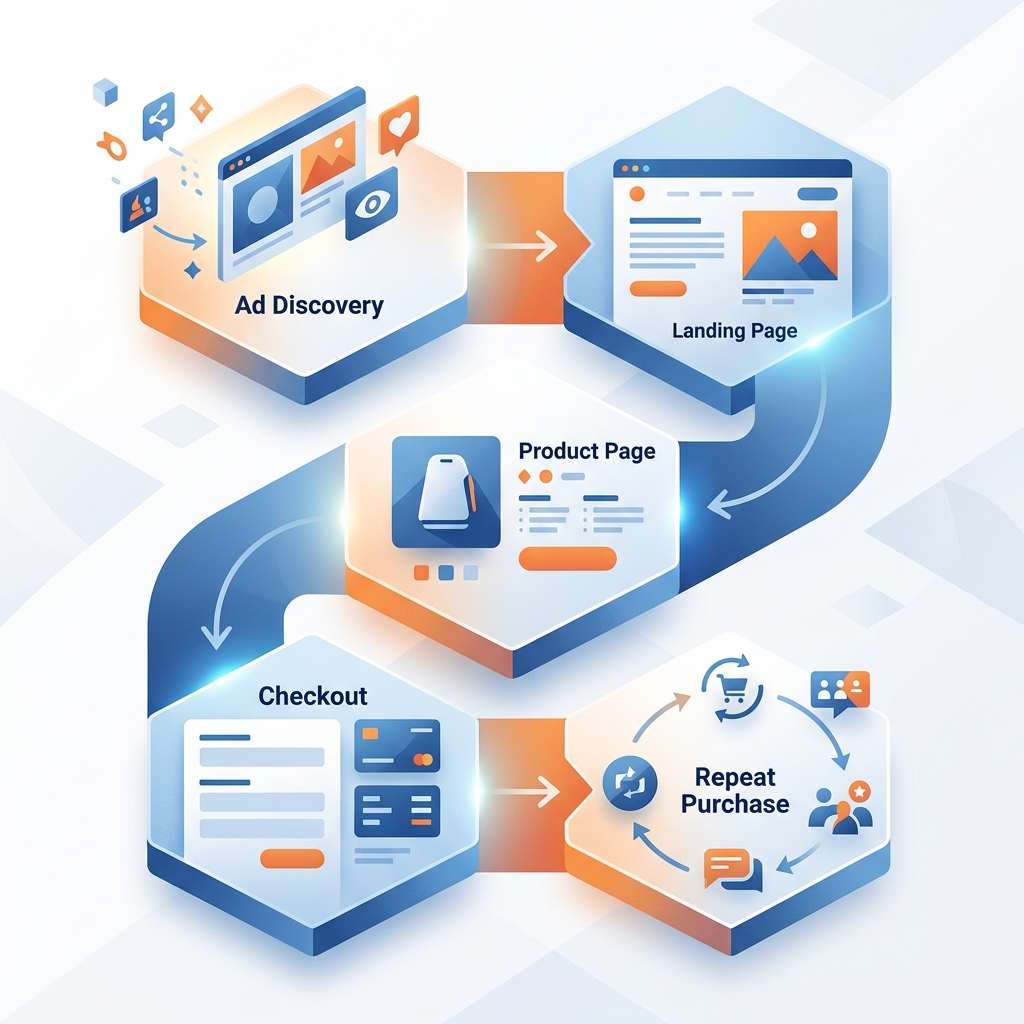
Ad → Relevant Landing Page → Offer → Proof → CTA → Checkout
Simple.
Boring.
Effective.
2. Stop Giving Customers a Menu. Give Them a Decision.
One of the biggest funnel mistakes is trying to sell everything at once.
Imagine a restaurant where the waiter says:
“Sir, today’s special is biryani. But we also have pizza, dosa, pasta, noodles, thali, sandwiches, Chinese, Mexican and continental.â€
You ask:
“What do you recommend?â€
He says:
“Everything.â€
You leave.
Your website often does exactly this.
A customer shouldn’t need a PhD in your product catalogue to understand what to buy.
The rule:
One campaign.
One audience.
One problem.
One offer.
One primary CTA.
This is the One-Offer Funnel Principle.
If you’re running an Instagram ad for a portable mini mop:
Don’t send customers to:
Homepage → Kitchen → Cleaning → Home Essentials → Mini Appliances → Product
Send them directly to:
Ad → Mini Mop Landing Page → Buy Now
That’s five fewer opportunities for the customer to disappear.
Shopify’s current ecommerce guidance makes a similar distinction: landing pages narrow the decision, while broader product pages and websites support discovery and exploration.
3. Write the Offer Before You Design the Page
This is where most entrepreneurs start backwards.
They open Canva.
Choose a beautiful gradient.
Find a stock photo of a smiling businessman.
Add a mountain.
Then spend 47 minutes deciding between two shades of blue.
Meanwhile, the customer still doesn’t know:
“Why should I buy this?â€
Start with the offer.
Before designing anything, write:
WHO
Who is this for?
PROBLEM
What annoying problem does it solve?
PROMISE
What outcome does the customer want?
PROOF
Why should they believe you?
PRICE
What does it cost?
CTA
What should they do next?
Then create your headline.

Weak headline:
Now I understand the proposition.
Premium Wireless Earbuds
Fine.
Very exciting.
So is a railway timetable.
Stronger:
Crystal-Clear Music Without Paying ₹5,000 for Earbuds
Or:
Your Commute Just Got Less Boring. Premium Sound Under ₹999.
Now we’re talking.
The headline should sell the outcome, not merely announce the existence of the product.
4. Build Landing Pages Like a Salesperson
A high-converting landing page doesn’t need 700 words of corporate poetry.
It needs answers.
The 10-second test
When someone lands on the page, they should understand:
What is this?
Who is it for?
Why should I care?
What should I do?
If they need to scroll five times to understand the product, your funnel has developed a serious case of Indian bureaucracy.

A simple landing-page structure
1. Headline
Clear promise.
2. Subheadline
Explain the benefit.
3. Product visual
Show the product in use.
4. Offer
Price, discount, bundle or bonus.
5. CTA
Buy Now / Get Started / Claim Offer.
6. Benefits
Three to five strong reasons.
7. Social proof
Reviews, ratings, testimonials, usage numbers.
8. Objection handling
Shipping?
Returns?
Warranty?
COD?
Delivery time?
9. FAQ
Answer the final doubts.
10. CTA again
Because customers have the attention span of a cricket fan during an IPL timeout.
Google also emphasizes clear calls to action, relevance between ad and destination, and mobile optimization.

5. For E-commerce, Your Ad Should Point to the Exact Thing
This is perhaps the biggest practical lesson.
Don’t do this:
Facebook Ad → Homepage → Customer searches → Category → Product → Cart
That’s a treasure hunt.
Your customer didn’t ask for an adventure.
Do this:
Facebook Ad → Product Landing Page → Add to Cart → Checkout
Or:
Google Search Ad → Relevant Product Page → Buy Now
Or:
Instagram Reel → Campaign Landing Page → Offer → Checkout
Google’s advertising guidance specifically recommends making the landing page closely match the ad and keyword theme.
The rule is simple:
The closer the click is to the promise, the shorter the path to purchase.
The Twist: AI Is Making This Even More Important
Here is where things get fascinating.
AI shopping is compressing the traditional buying journey.
Someone asks:
“Find me a compact air fryer under ₹5,000 that’s good for a family of four.â€
The AI researches.
Compares.
Filters.
Recommends.
The customer clicks.
They may land directly on a specific product page, not your homepage.
Shopify’s Q1 2026 data found that more than half of AI-referred sessions started on product detail pages, compared with about 20% for organic search.
That means your product page is increasingly becoming a sales pitch.
Not merely a catalogue entry.
Your product page needs:
- Clear product name
- Strong benefit-led headline
- Detailed specifications
- High-quality images
- Video where useful
- Reviews
- FAQs
- Shipping information
- Returns
- Availability
- Strong CTA
- Structured product information
AI search also makes product data more important.
An AI shopping assistant needs to understand:
What is the product?
Who is it for?
What problem does it solve?
What does it cost?
What are its features?
How does it compare?
Why should someone trust it?
The boring details suddenly become extremely valuable.
The New Funnel Is Not Just a Funnel
In 2026, think of it like this:
                    DISCOVERY
                       ↓
        Google / Instagram / YouTube / AI
                       ↓
                    AD / POST
                       ↓
             RELEVANT LANDING PAGE
                       ↓
                  THE OFFER
                       ↓
                  SOCIAL PROOF
                       ↓
                     CTA
                       ↓
                   CHECKOUT
                       ↓
                   PURCHASE
                       ↓
              RETARGET / UPSELL
                       ↓
               REPEAT PURCHASE
And now add AI:
AI SEARCH
   ↓
Product Recommendation
   ↓
Product Page
   ↓
Trust
   ↓
Offer
   ↓
Purchase
The funnel is becoming shorter.
That is good news for businesses with strong offers.
It is terrible news for businesses with confusing product pages.
The AI Funnel Opportunity
Modern AI tools also make funnel creation faster.
You can use AI for:
Research
Find customer pain points, objections and buying motivations.
Copywriting
Generate headline variations, ad copy, FAQs and product descriptions.
Creative
Create multiple ad concepts and product visuals.
Personalization
Adapt messaging according to traffic source, audience and intent.
Analytics
Identify where visitors abandon the funnel.
A/B testing
Test different headlines, offers and CTAs.
AI-powered personalization is one of the major ecommerce trends for 2026, alongside conversational AI, AI agents, predictive analytics and multimodal AI.
But remember:
AI creates variations.
Strategy chooses the winner.
Don’t create 37 landing pages because your AI tool got excited.
Create three.
Test them.
Keep the winner.
Kill the losers.
Move on.
The Indian E-commerce Funnel
Indian customers bring their own flavour to conversion.
Trust matters.
Price matters.
Delivery matters.
COD matters.
Reviews matter.
And somewhere in the buying journey, someone is asking:
“Return hai na?â€
So your landing page should answer objections before the customer asks.
Example:
🔥 ₹999 Today
Portable Mini Mop
Clean kitchen spills in seconds without dragging out the big mop.
✓ Compact design
✓ Easy to store
✓ Perfect for kitchen & bathroom
✓ Cash on Delivery available
✓ Easy returns
[ BUY NOW ]
★★★★★
“Very useful for quick cleaning.â€
Then:
Free delivery above ₹X
7-day return policy
Ships across India
That’s clarity.
Your Funnel Scorecard
Don’t obsess over likes.
Track the journey.
| Funnel Stage | Metric |
|---|---|
| Ad | CTR |
| Landing Page | Bounce/engagement |
| Offer | CTA click rate |
| Product | Add-to-cart rate |
| Checkout | Checkout completion |
| Purchase | Conversion rate |
| Customer | Repeat purchase rate |
| Economics | CAC, AOV, ROAS |
Here’s the uncomfortable truth:
A 5% increase in ad CTR doesn’t save a terrible landing page.
If 1,000 people click your ad and only 5 buy, your problem isn’t necessarily traffic.
Your funnel is leaking.
Find the hole.
Fix the hole.
Then buy more traffic.
Not the other way around.
Google recommends regularly evaluating landing-page performance and highlights mobile optimization and page speed as important parts of the experience.
The Funnel Mental Model
Here’s the mental model I would remember:
Don’t optimize the website. Optimize the journey.
Your homepage answers:
“Who are we?â€
Your landing page answers:
“Why should you care?â€
Your product page answers:
“Why should you buy this?â€
Your checkout answers:
“How do I pay?â€
Your post-purchase experience answers:
“Why should I come back?â€
Different pages.
Different jobs.
Different psychology.
Tweet This
Indian e-commerce in 2026:
Customer: “I want this product.â€
Brand: “Sure. First visit our homepage, check our About Us page, browse 17 categories, follow us on Instagram, read our blog and subscribe to our newsletter.â€
Customer: “Bhai rehne do.â€
Funnel: Ad → Product → Offer → Buy.
Sometimes simplicity is the real growth hack.
Your customer clicked an ad for ₹999 earbuds.
Don’t send them to a homepage with 48 products.
That’s not a funnel.
That’s Big Bazaar with Wi-Fi.
Cricket lesson for marketers:
If the batsman needs six runs, don’t give him a 14-page strategy document.
Tell him the target.
Give him the ball.
Let him swing.
Clarity improves action.
Your website has 27 menu items.
Your customer has 8 seconds of patience.
This is not a fair fight.
The 5-Rule Funnel Framework
If you remember nothing else, remember this:
1. Website ≠Funnel
Keep the website for the brand.
Use funnels for focused conversion campaigns.
2. Remove Choice
One campaign.
One audience.
One offer.
One primary CTA.
3. Sell the Offer First
Don’t start with colours, fonts and animations.
Start with:
Problem → Promise → Proof → Price → CTA
4. Build Landing Pages
Every major campaign deserves a relevant destination.
5. Connect Ads Directly to Intent
The customer clicks an ad for a product.
Show the product.
The customer clicks an ad for an offer.
Show the offer.
The customer searches for a specific solution.
Show the solution.
Don’t make them hunt.
The Final Mental Model
The internet has changed.
Search is changing.
AI is changing discovery.
Social commerce is changing attention.
Agentic commerce is changing product research.
But one principle remains stubbornly alive:
People don’t buy because your website is beautiful.
They buy because:
The right person saw the right message,
at the right moment,
with the right offer,
and the next step was obvious.
That’s the funnel.
Not some complicated diagram hanging on a marketer’s wall.
Not 17 automations.
Not another ₹80,000 software subscription.
Clarity.
And perhaps the most profitable question you can ask about your business today is:
“If I removed everything unnecessary from this buying journey, what would remain?â€
Start there.
Then build the funnel.
Explore more practical mental models, marketing strategies, AI frameworks, productivity systems and wealth-building insights at VoittoInsights.in.
Discover more from Voitto Insights
Subscribe to get the latest posts sent to your email.

Voitto Insights
I am passionate about helping others have the right mindset to overcome challenges. Financial independence plays an important role in having that right mindset. I will also post regarding trading and investment ideas. Earlier had successfully completed two masters in management degrees. I am a working professional with more than a decade experience in multiple industries. Disclaimer: Kindly note that, I am not a Sebi registered investment advisor. Please do your own due diligence before taking any action on the posts here. All posts are for educational purposes only.


You May Also Like

Wishing a great new year 2022 !

Focus on number of experiences in a year not number of years of experience !
