Voitto Insights

Salaried and stopped your SIP in a tight month? Here’s what that pause really costs, why it isn’t the real danger, and a 10-minute plan to restart without guilt.

Raise your hand if this has happened to you.
A big expense lands. A wedding, a medical bill, a car repair, a notice period that ran longer than planned. You open your banking app, find the SIP mandate, and hit pause. “Just for a few months,” you tell yourself.
Then a few months becomes a year. Then you forget it’s paused at all.
Here’s the uncomfortable truth, in rupees. And then a twist that should make you feel better, not worse.
1. The setup (one SIP, two decisions)
Let’s take one simple SIP:
- ?10,000 a month
- for 20 years
- at an assumed 12% a year
Example maths, not promised returns. Markets don’t move in straight lines. But a steady assumption lets us compare choices fairly.
Kept going without a break, this SIP grows to about ?99 lakh. You’d have put in ?24 lakh of your own money. Compounding does the rest.
Now let’s look at the two things that happen in real life.
2. The pause (it hurts, but less than you think)
Say you pause in year 3 for 12 months, then restart at the same ?10,000 and carry on to year 20.
You end with about ?89.3 lakh. That’s roughly ?9.7 lakh less than the unbroken SIP.
Read that again. You skipped ?1.2 lakh of investing. It cost you about ?9.7 lakh at the end. That’s what early money does: it has the most years to grow, so missing it costs the most.
A few more versions, same assumptions:
| What you did | Ends with | Cost vs no break |
|---|---|---|
| Never paused | about ?98.9 lakh | 0 |
| Paused 6 months in year 3 | about ?94.0 lakh | about ?5.0 lakh |
| Paused 12 months in year 3 | about ?89.3 lakh | about ?9.7 lakh |
| Paused 12 months in year 15 | about ?96.6 lakh | about ?2.3 lakh |
Example maths at an assumed 12% a year. Not advice.
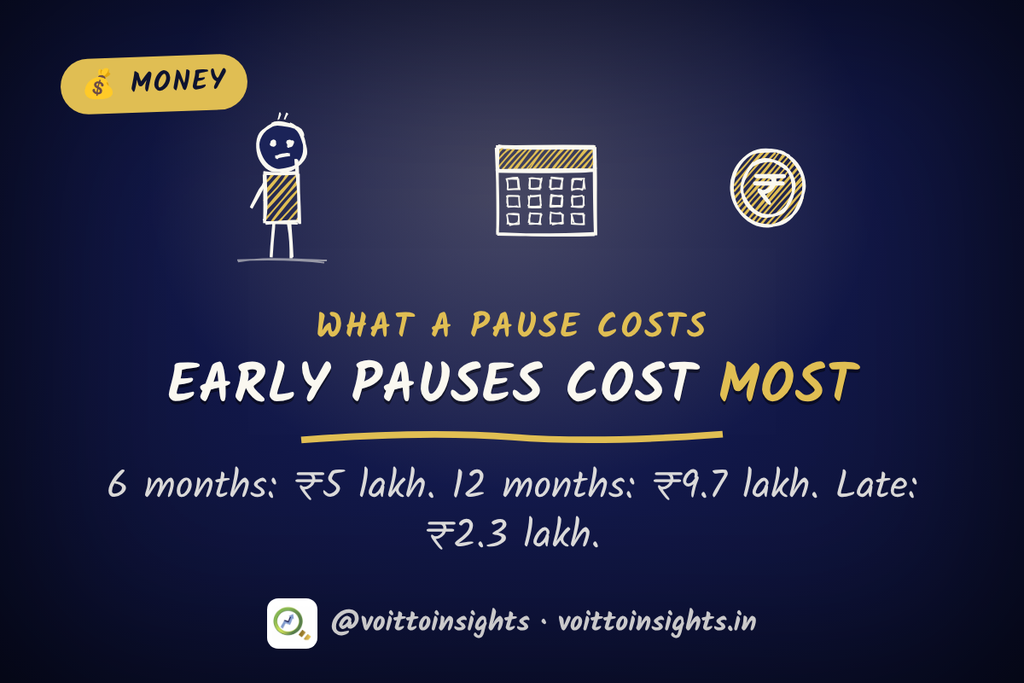
Notice the last row. A pause late in the journey costs far less than a pause early on. So if you ever must pause, the early years are the ones to protect hardest.
3. The twist (the pause was never the real danger)
Here’s the number that matters.
Say you paused in year 3 and simply never restarted. Life got busy. The mandate stayed off. The money you’d already invested kept growing on its own for 18 more years.
You’d end with about ?23 lakh.
Not ?89 lakh. Not ?99 lakh. ?23 lakh.
| What you did | Ends with |
|---|---|
| Never paused | about ?98.9 lakh |
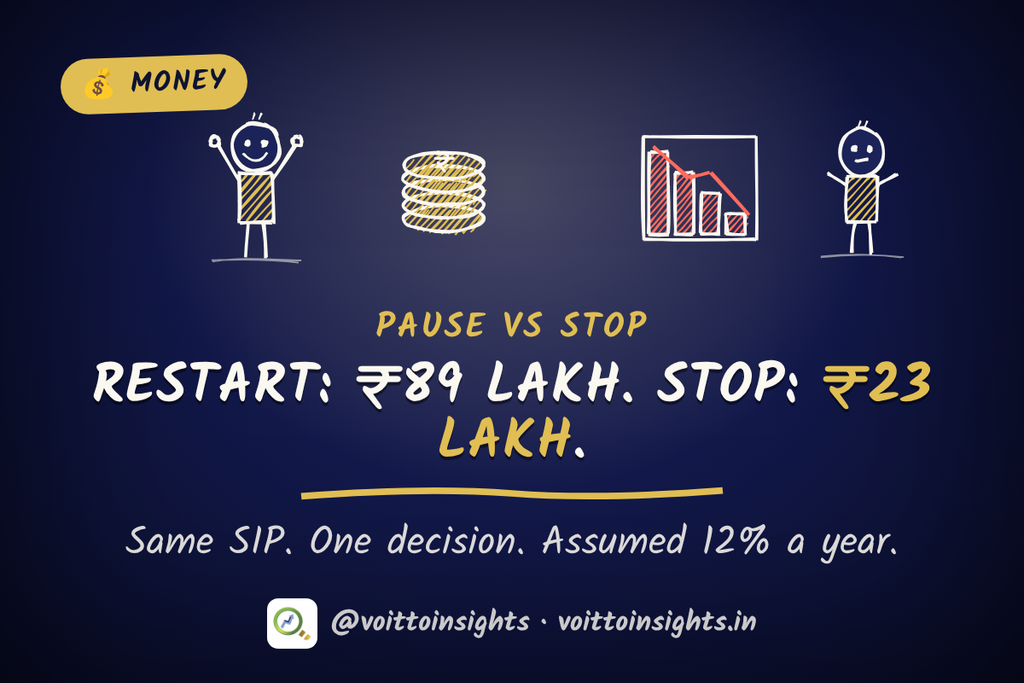
| Paused 1 year, then restarted | about ?89.3 lakh |
| Stopped after 2 years for good | about ?23.1 lakh |
| Stopped after 5 years for good | about ?49.0 lakh |
The one-year pause costs about ?9.7 lakh. The forgotten pause costs about ?76 lakh.
So the pause isn’t the villain. The forgetting is.
4. The mental model (you’re stuck where you stopped)
Farnam Street’s Brain Food newsletter shared a line this week that fits this perfectly:
“You’re not stuck where you started. You’re stuck where you stopped.”
Most people who stop investing don’t stop because they decided to. They stop because they paused and never got back. The pause turns into a habit. The habit turns into a story: “I’m just not good with money.”
But you’re not stuck at the start. You’re stuck at the exact point where you stopped. Which means the fix is also exact: restart from there.
Tweet this: The SIP pause costs lakhs. The forgotten restart costs your future. Restart any amount this month.
5. How to restart in 10 minutes (no guilt, no catch-up)
Step 1: Restart with any amount. If ?10,000 feels heavy right now, restart at ?2,000. A running SIP at ?2,000 beats a paused one at ?10,000. You can raise it later.
Step 2: Fix the date. Set the auto-debit for 1 to 3 days after salary credit. Money that leaves before you can spend it doesn’t get spent.
Step 3: Don’t chase the gap. You don’t need to “make up” the missed months in one go. Even a small, steady top-up works. In our example, restarting at ?11,000 instead of ?10,000 after a one-year pause gets you to about ?95.9 lakh, close to the no-pause result.
Step 4: Set a “restart date” the day you pause. If you ever pause again, put a reminder in your calendar the same day: “Restart SIP.” Name a date. A pause with a date is a plan. A pause without one is a stop.
Step 5: Check once a quarter. Open your SIP list every three months. Is everything running? This one habit prevents the ?76 lakh mistake.
6. Your SIP scorecard (be honest)
Give yourself 1 point for each yes:
- All my SIPs are running right now.
- My SIP date is within 3 days after salary.
- I increased my SIP at my last appraisal.
- If I paused before, I wrote down a restart date.
- I checked my SIP list in the last 3 months.
5 points: you’re on autopilot. Protect it. 3 to 4: one small fix away. Pick the lowest one and do it today. 0 to 2: don’t feel bad. Restart one SIP at any amount this week. That alone moves you from “stopped” to “started”.

7. FAQs
Is it okay to pause a SIP in an emergency? Yes. That’s what an emergency is. Just pause with a restart date, and if you can, keep a smaller amount running instead of stopping completely.
Should I invest a lump sum to make up for the pause? Only if you have spare money after your emergency fund. Otherwise, a small monthly step-up is easier and still closes most of the gap in our example.
Do these numbers mean I’ll get 12%? No. 12% is an assumption for comparing choices. Real returns go up and down. The lesson is about time and consistency, not a promised number.
Is it better to pause early or late? If you must pause, a late pause usually costs less in this kind of example, because early money has more years to grow. Protect your early years.
Final takeaway
The ?9.7 lakh pause isn’t what hurts most. The ?76 lakh stop is.
You’re not stuck where you started. You’re stuck where you stopped. So restart from there, with any amount, this month.
Want a quick check of your whole salary setup? Comment CHECKUP on our latest Instagram post and we’ll DM you our 6-step salary money checkup.
Discover more from Voitto Insights
Subscribe to get the latest posts sent to your email.