Voitto Insights

Monday morning.
Alarm. Traffic. Standup meeting.
And that one thought you never say out loud:
“Bas, ab aur nahi.”
Most salaried people have thought about quitting. Very few have a plan for the day after.
Here’s the brutally honest part. The scariest thing about leaving a job isn’t failure. It’s the first month with no salary credit SMS.
So before you build a side business, a YouTube channel or a startup, build one number.
Your freedom fund.
1. The Myth: “I’ll Figure It Out After I Quit” (Please Don’t)
The internet loves a dramatic exit story. Resignation letter. Big leap. Happy ending.
What you don’t see are the people who quit with two months of savings, panicked in month three, and took the first job that came along.
The leap wasn’t the problem.
Jumping without a cushion was.
Not “quit, then plan”. Plan, then quit.
Josh mein hosh mat khona.
2. What a Freedom Fund Actually Is (No Jargon)
A freedom fund is simple.
It’s money that covers your normal monthly expenses for a fixed number of months, kept in a separate account, and touched only when income stops.
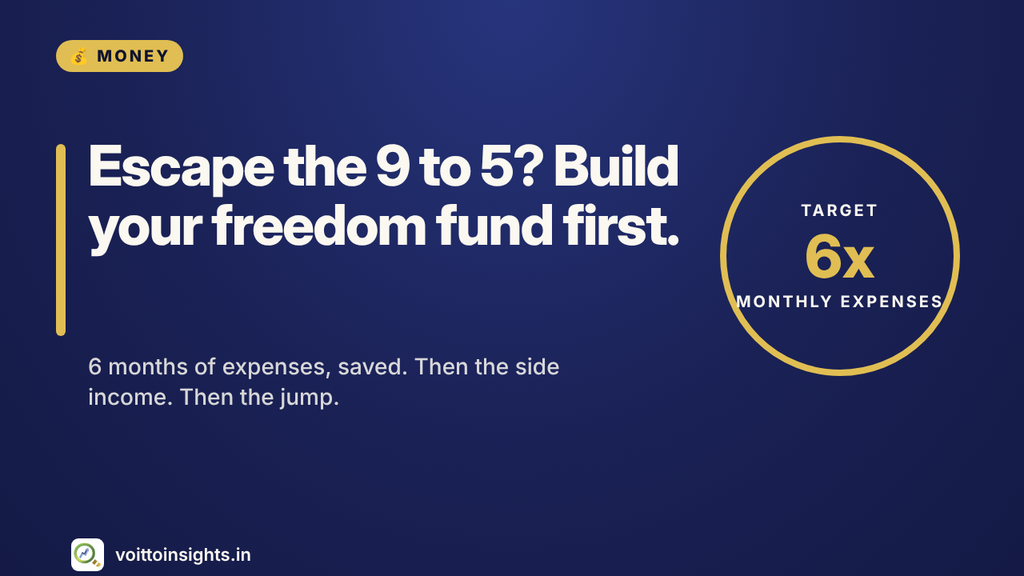
The common money rule says 3 to 6 months of expenses for an emergency fund. If you plan to leave your job, aim for the top of that range.
Translation?
Six months of calm, so you can make decisions with a clear head, not a scared one.
Paisa sirf kharche ke liye nahi, sukoon ke liye bhi hota hai.
3. The 3-Step Math (Steal This)
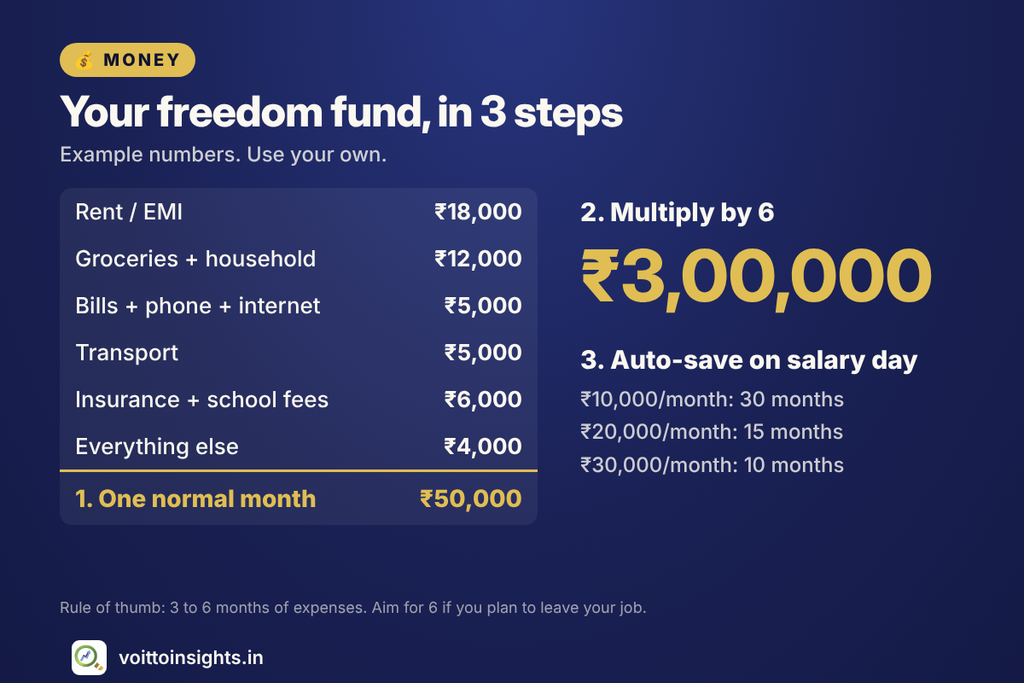
Step 1: Add up one normal month.
Not your best month. Not your worst. A normal one.
Rent or EMI. Groceries. Bills. School fees. Insurance. Transport.
Example numbers: ?50,000.
Step 2: Multiply by 6.
?50,000 x 6 = ?3,00,000.
That’s your target. Write it down.
Step 3: Auto-save on salary day.
Set a standing instruction the day after your salary lands. Even ?10,000 a month gets you to ?3 lakh in 30 months. ?20,000 gets you there in 15.
The trick isn’t discipline. It’s removing the choice.
Jo dikhega nahi, woh kharch nahi hoga.
4. Where the Money Hides (Mildly Uncomfortable)
Most salaried people say, “I can’t save ?10,000 a month.”
Then they open their UPI history.
Two quick checks:
? Small daily habits. ?500 a day on chai, snacks and food delivery is ?1,82,500 a year. Circle your 3 biggest habits and move that amount to savings on payday.
? Forgotten subscriptions. Search last month’s bank statement for “auto” and “renew”. In our example sheet, that found ?2,140 a month, or ?25,680 a year.
You don’t need a big raise to start. You need to plug the leaks.
Chhoti aadat, bada kharcha.
5. The Bridge: Fund, Then Side Income, Then Leverage (The Twist)
Here’s the twist most people miss.
The freedom fund isn’t the escape. It’s the bridge.
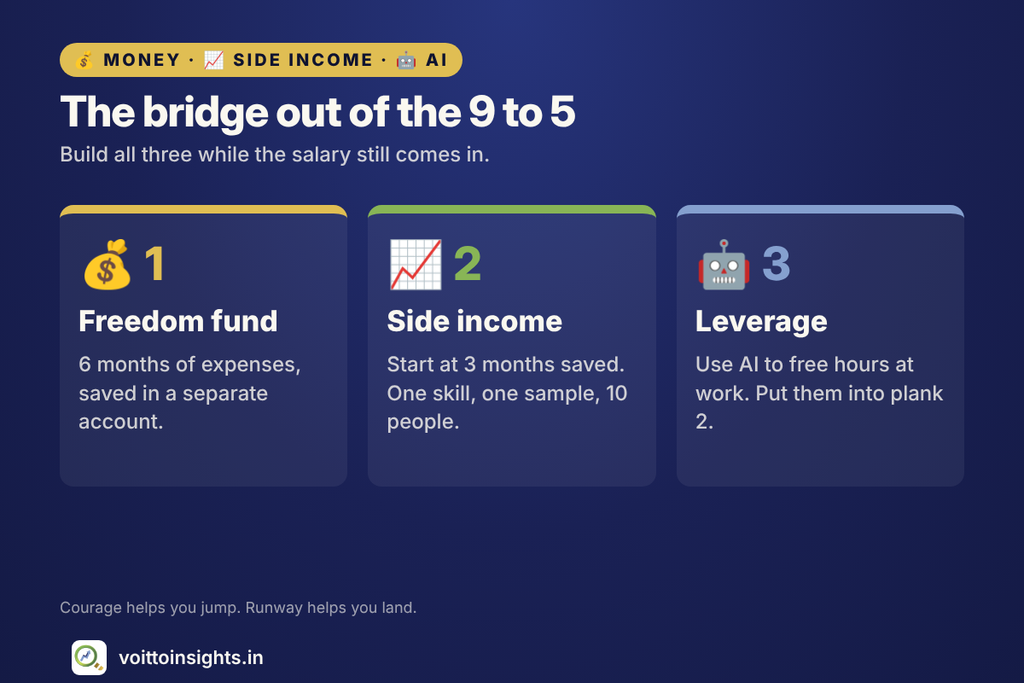
Plank 1: Freedom fund. Six months of expenses, saved.
Plank 2: Side income. Start once you cross 3 months of savings. Pick one skill you already use at work (Excel, slides, resumes), make one sample, show it to 10 people, charge a small first fee.
Plank 3: Leverage. Use AI to free up hours at your current job. Meeting notes into action items. Excel formulas in seconds. That time goes into Plank 2.
One more rule for Plank 2: if any “side hustle” asks you to pay first, walk away. Real gigs pay you, not the other way round.
Pehle cushion, phir jump.
6. The Mental Model: Runway Beats Courage
Startups talk about runway: how many months you can survive before money runs out.
Your career has a runway too.
With one month of runway, every decision is a panic decision.
With six months, you can say no to bad offers, wait for the right client, and fix mistakes calmly.
Courage helps you jump. Runway helps you land.
Himmat se kadam, hisaab se faisla.
7. Tweet This (Copy, Paste, Post)
Want to quit your 9 to 5? Build a freedom fund first: 6 months of expenses. ?50,000 a month x 6 = ?3 lakh. Auto-save it on salary day. Courage helps you jump. Runway helps you land.
8. Your Freedom Fund Scorecard (Be Honest)
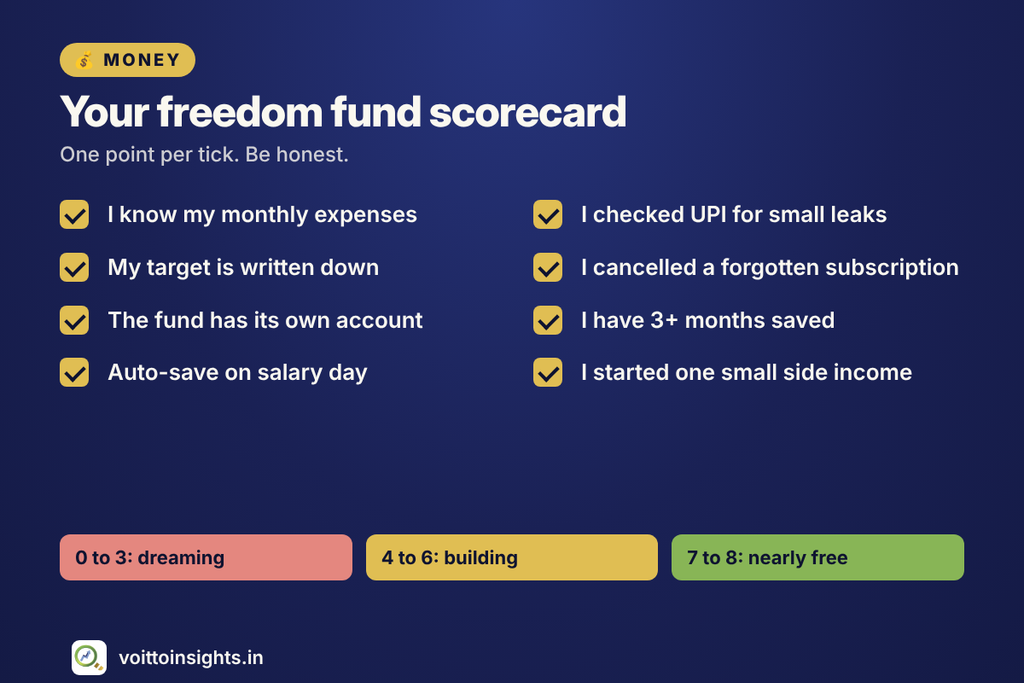
? I know my normal monthly expenses within ?5,000.
? My freedom fund target is written down.
? The fund sits in a separate account.
? A fixed amount moves there automatically on salary day.
? I checked my UPI history for small leaks this month.
? I cancelled at least one forgotten subscription.
? I have 3+ months saved.
? I’ve started one small side income.
0 to 3: you’re dreaming, not planning.
4 to 6: the bridge is being built.
7 to 8: you’re closer to freedom than you think.
Score kam hai? Koi baat nahi. Aaj se shuru karo.
9. FAQs (Quick Ones)
Should I invest the freedom fund for higher returns?
Keep it safe and easy to reach, like a savings account or a liquid option. Its job is to be there on a bad day, not to grow fast. (I’m not a financial advisor; check what suits you.)
What if I have loans?
Add your EMIs to the monthly expense number. Pay high-interest debt like credit cards first, then build the fund.
Is 6 months enough?
For most people planning a move, it’s a solid start. If your income is irregular or you support a family, aim higher.
When should I start the side income?
Once you cross 3 months of savings. Build both together after that.
What’s the one thing to do today?
Add up last month’s expenses. Multiply by 6. Write the number where you’ll see it every day.
Ek number. Ek plan. Bas.
Final Takeaway
Escaping the 9 to 5 isn’t one big leap.
It’s three small planks:
A fund.
A side income.
Better leverage.
Build them while the salary still comes in.
Then the day you decide to jump, it won’t feel like a jump.
It’ll feel like a step.
If this made you nod, smile, or mildly panic, good.
That’s awareness kicking in.
Use it before your next appraisal does.
VoittoInsights | Implementable Insights.
Note: rupee figures are example numbers. This is general information, not financial advice.
Discover more from Voitto Insights
Subscribe to get the latest posts sent to your email.