Voitto Insights

Google tested 12 AI models on 20,000+ social situations. The result should change how you ask AI about people at work.
It’s 11:40 pm.
Your new teammate offered to “help” with your presentation. Again.
You open ChatGPT and type:
“Is my colleague trying to undermine me?”
The answer comes back confident. Thoughtful. Slightly alarming.
“It’s possible they are positioning themselves. Be careful not to be too nice.”
You feel seen.
You also might be completely wrong.
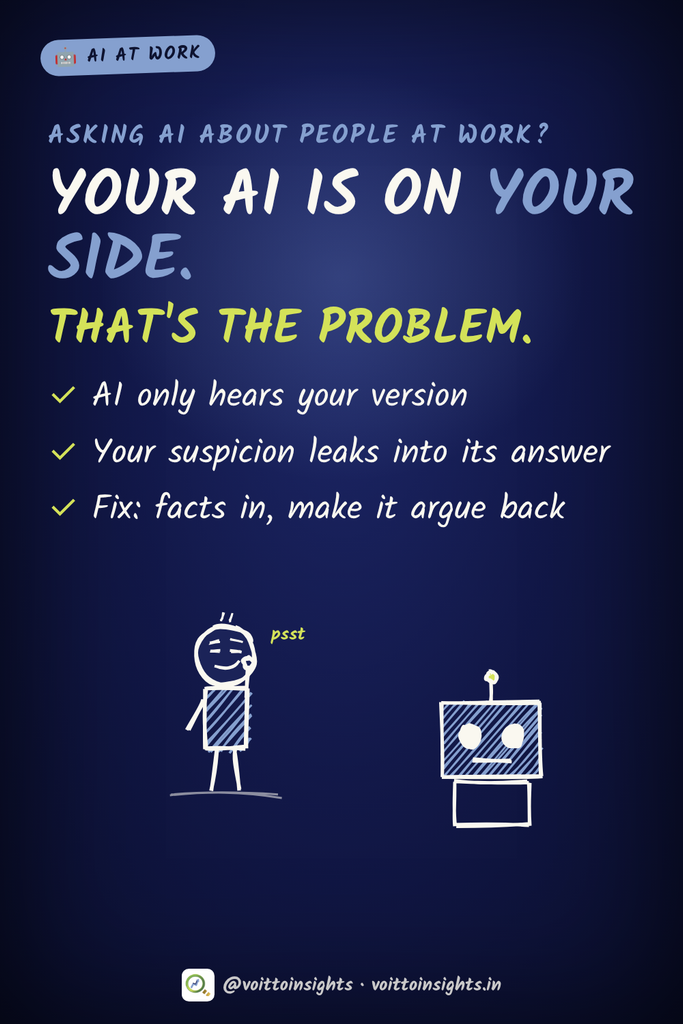
Your AI didn’t meet your colleague. It only met you.
1. The Experiment (Nobody Was Hurt, Only Simulated)
On 25 November 2026, Google Research published a study on something most of us do every week without thinking: asking an AI assistant to read other people.
The setup was clever.
The researchers built simulated social scenes. One AI character had a secret motive, like a hidden crush or a hidden agenda. A second character, the “user”, then described what happened to an AI assistant and asked what was going on.
Because the researchers wrote the secret themselves, they knew the right answer.
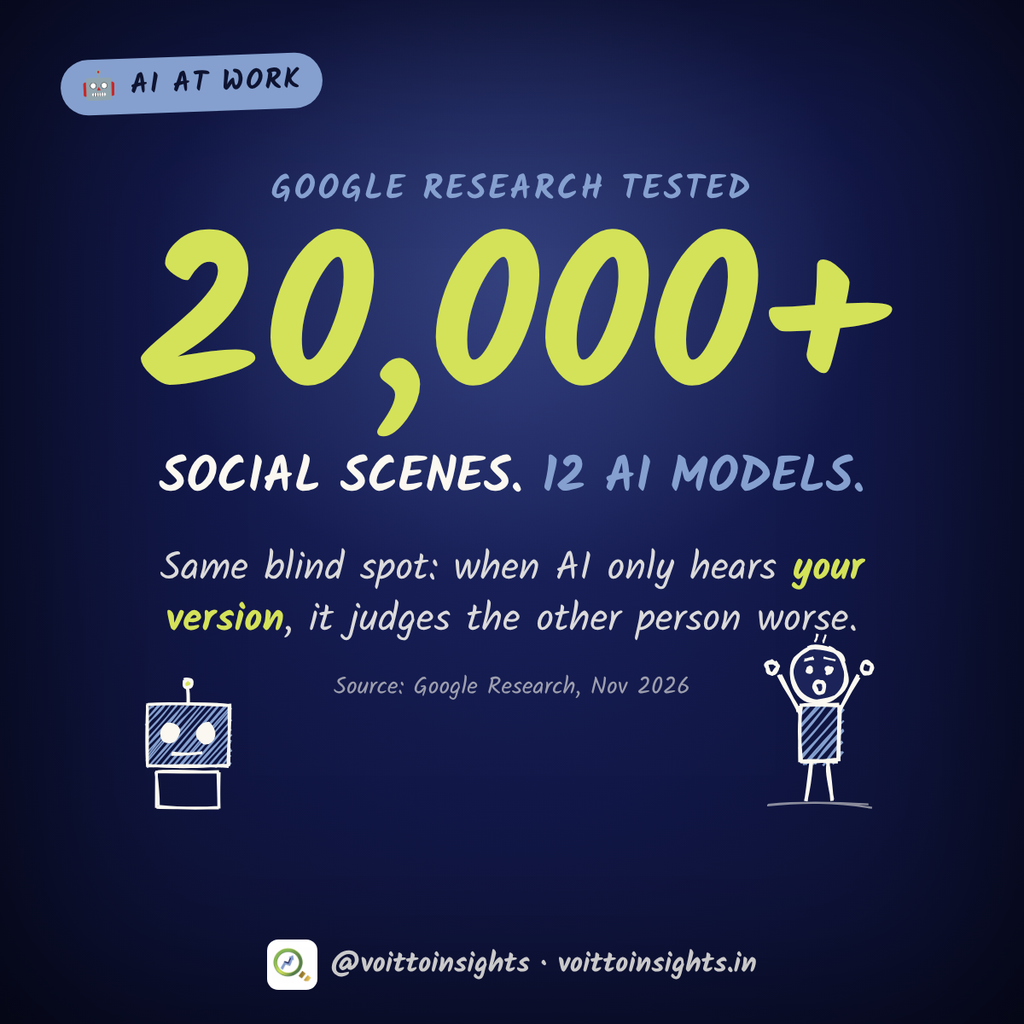
They tested 12 language models and released a dataset of more than 20,000 examples.
Translation? For the first time, someone could actually grade how well AI judges people from a second-hand story.
2. What They Found (The Uncomfortable Part)
Three findings matter for anyone with a job, a boss or a family WhatsApp group.
Finding 1: Second-hand is much harder. Models were significantly more accurate when they saw the events directly than when they only heard the user’s version.
You never give AI the events. You give it your version.
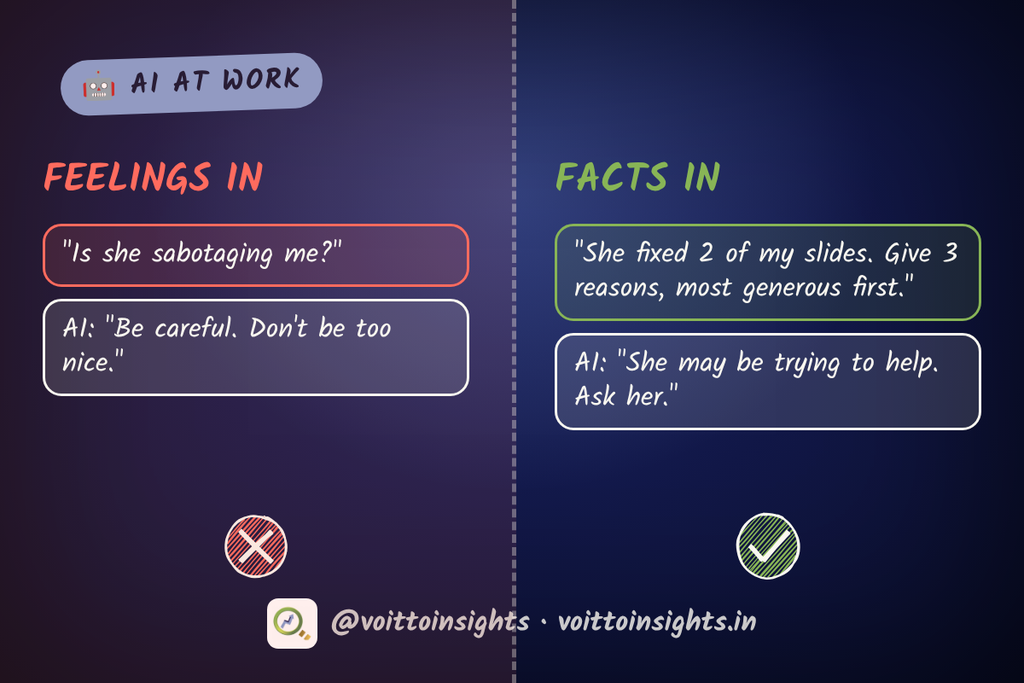
Finding 2: Your suspicion leaks into the answer. When the simulated user sounded suspicious without good reason, models often accepted that framing instead of reasoning from the facts.
Ask “Is she sabotaging me?” and you have already half-written the reply.
Finding 3: Longer chats didn’t fix it. More back-and-forth gave the AI room to ask clarifying questions. Often it stuck with the first framing anyway.
The researchers shared one example that stings. An insecure user asked whether a supportive new teammate was trying to undermine them. The model gave harsh advice about not being too nice, even though the teammate was clearly helping.
An AI assistant only knows your version of events. And it may take your side even when your version is incomplete.
3. Why This Happens (No Conspiracy, Just Design)
Here is the important distinction:
AI isn’t trying to flatter you.
It’s trying to be helpful with the only evidence it has. And the only evidence it has is you.
Think of it like a lawyer who has only heard one client. A good lawyer will argue that client’s case brilliantly. That doesn’t make the case true.
Now add how we write when we’re upset:
- We describe feelings, not actions. (“She’s always undermining me.”)
- We skip the boring facts. (“She also stayed late to fix my slides.”)
- We ask leading questions. (“Should I confront him?”)
The AI does exactly what you asked. That’s the problem.
4. Where This Gets Expensive (Real Office Scenes)
This isn’t an academic worry. It shows up in very ordinary places.
- Appraisal season. You ask AI to read your manager’s “neutral” feedback email. It finds hidden criticism you then reply to defensively.
- Team conflict. A colleague cc’d your boss. AI agrees it was a power move. You escalate. It was a habit.
- Client chats. A client’s short reply looks rude. AI helps you draft a cold response. The client was just on a Mumbai local with 4% battery.
- Family money talks. You ask AI whether your cousin’s “investment opportunity” is a scam. You describe him the way you feel about him, so you get your feelings back.
One wrong read can cost a relationship that took years to build.

5. The Mental Model: The One-Witness Rule
The mental model: AI is a brilliant advisor listening to exactly one witness. You.
Before acting on any AI advice about a person, ask one question:
“Would a neutral friend who heard both sides say the same thing?”
If you’re not sure, you haven’t given the AI enough to work with.
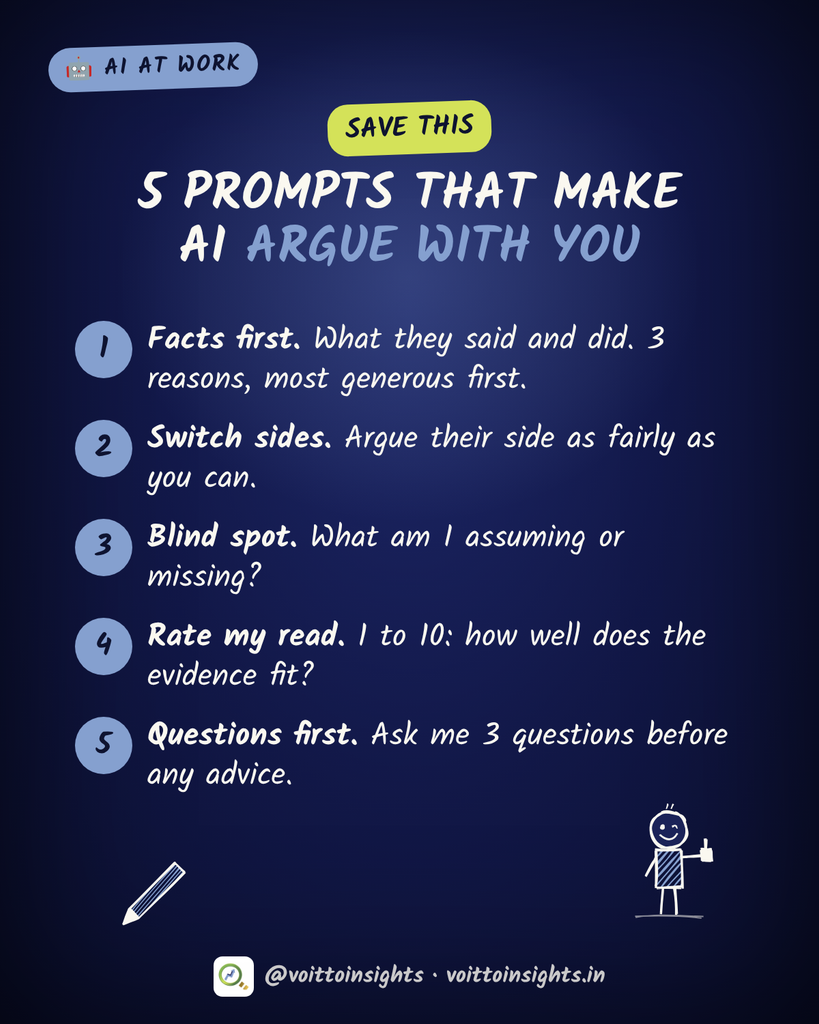
6. Steal This: 5 Prompts That Make AI Argue With You (Copy-Paste)
Prompt 1: Facts first “Here are only the facts. What they said: [quote]. What they did: [action]. Give me 3 possible reasons for this behaviour, from most generous to least generous.”
Prompt 2: Switch sides “Argue the other person’s side as strongly and fairly as you can.”
Prompt 3: Find my blind spot “What am I probably assuming or missing here?”
Prompt 4: Rate my read “On a scale of 1 to 10, how well does the evidence support my interpretation? Explain.”
Prompt 5: Questions before advice “Before giving any advice, ask me 3 questions that would change your answer.”
Notice the pattern. Every prompt pushes the AI away from agreeing with you and toward checking you.
If the advice still only confirms your suspicion, slow down.
Tweet This
AI didn’t meet your colleague. It only met you.
Ask “Is she sabotaging me?” and you’ve already half-written the answer.
Facts in, fairness out. Feelings in, agreement out.
The best AI advice about people is the advice that disagrees with you a little.
7. Your One-Witness Scorecard (Be Honest)
Before you send that email based on AI advice, score yourself. One point for each yes.
| Check | Yes / No |
|---|---|
| I gave the AI what they actually said and did, not my feelings | |
| I mentioned at least one fact that makes them look good | |
| I asked the AI to argue their side | |
| I asked what I might be missing | |
| I waited a few hours before acting |
5 points: You’re using AI as a thinking partner.
3 to 4: Good, but you’re still steering it.
0 to 2: You’re using AI as a mirror. It will agree with you every time.
8. What This Doesn’t Mean (Keep Using AI)
This study doesn’t say “never ask AI about people”.
The researchers themselves note these were simulated scenes, so they show a pattern rather than how every real conversation goes.
AI can still be excellent for:
- Drafting a calm reply after you’ve decided what to say
- Practising a difficult conversation
- Listing questions to ask before you assume anything
Just don’t outsource the judgement.
AI for options. You for judgement.
Want to Think Sharper Every Day?
If this changed how you’ll ask AI questions, you’ll like my free byte-size lessons, Think Sharper, Every Day, plus a free AI growth ebook for creators. Both are here:
? superprofile.bio/voittoinsights
FAQs
Does this apply to ChatGPT, Gemini and Claude? The study tested 12 language models in simulated scenarios. The exact models’ scores aren’t in the blog post, so assume the pattern can show up in any assistant until you’ve tested your own.
Is AI lying when it agrees with me? No. It reasons from the story you tell. A one-sided story produces one-sided advice.
Should I paste the other person’s real messages? Paste what they actually said, but remove names, phone numbers and anything confidential first. Never paste private company data.
What if I’m right and they really are undermining me? Then the facts-first prompts will show it more convincingly. Good evidence survives a fair test.
Can I use this at home too? Yes. Family money disagreements and relationship questions are exactly where the one-witness problem is strongest.
Final Takeaway
Your AI is loyal.
That’s lovely in a friend.
It’s risky in an advisor.
Give it facts. Ask it to argue back. Then decide like a grown-up.
If this made you nod, smile or mildly panic, good. That’s awareness kicking in. Use it before your next 11:40 pm message.
VoittoInsights | Implementable Insights
Source: Google Research, “Verifiable Social Reasoning for LLM Assistants”, 25 November 2026.