Voitto Insights
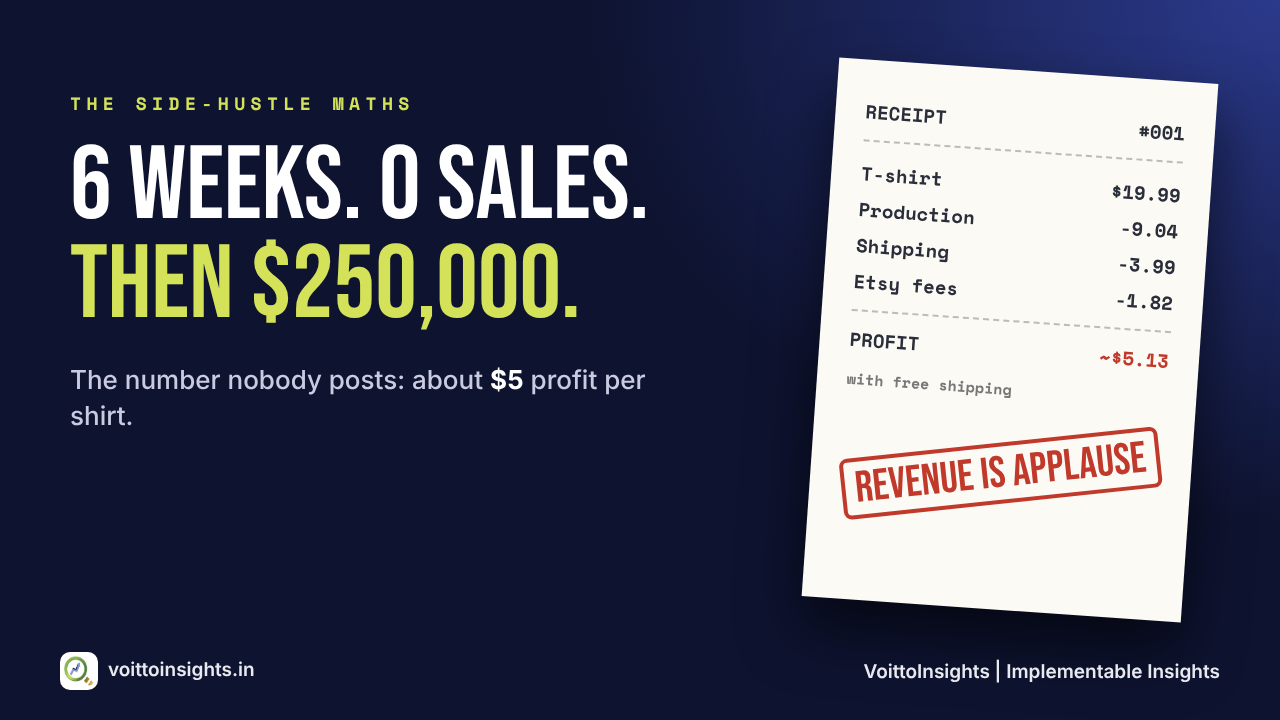
(The Side-Hustle Maths Nobody Posts)
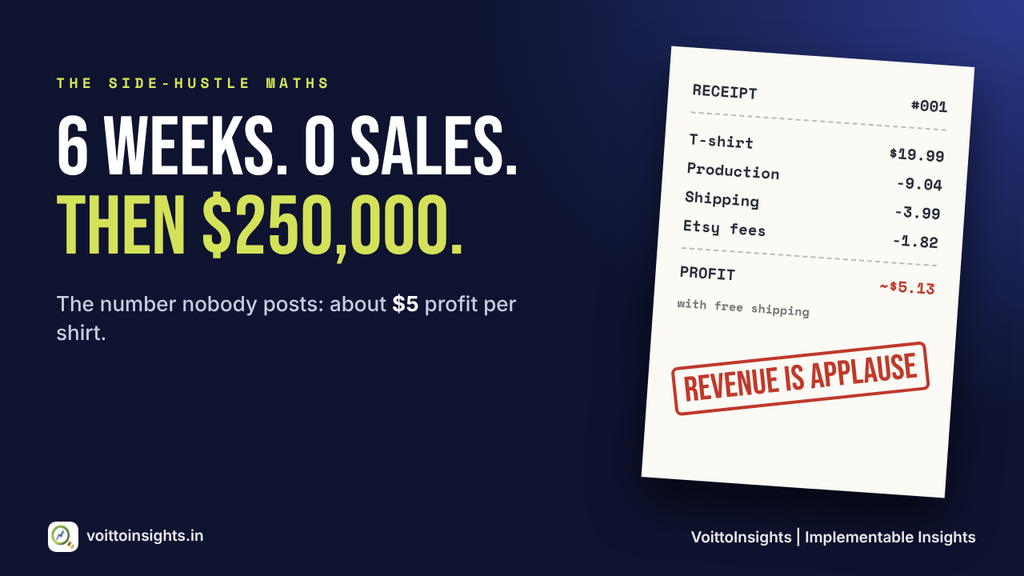
Twelve-hour hospital shifts.
A new Etsy shop.
Six weeks.
Zero sales.
Most people quit right there. Honestly? Most people should have.
She didn’t.
By the end of year one, that shop had crossed $250,000 in revenue. That’s over ?2 crore.
Now here’s the part Instagram will never show you:
On her best-selling T-shirt, she kept about $5.
Not $50. Not $15. Five.
This post is about that gap. The gap between the number people screenshot and the number that pays the rent. And how you can check your own gap in 10 minutes, before you spend another rupee on ads.
Revenue is applause. Profit is the salary.
1. The Story (No Filter)
Heather was an MRI technologist. Long shifts. Little spare time.
She started a print-on-demand shop on Etsy. Translation? She uploads designs. A printing partner prints the shirt only after someone orders it, then ships it. No stock. No warehouse. No ?5 lakh sitting in cartons in your spare room.
Sounds like the perfect side hustle.
The catch?
Six weeks of silence. No orders.
Then the shop started moving. By the end of year one: about $250,000 in revenue, with a gross margin of over 30% before tax, according to her own numbers shared on Making Sense of Cents.
Good business. Genuinely.
But “$250K” and “rich” are not the same sentence.
2. The Receipt (Steal This)
Here is one $19.99 T-shirt, line by line:
| Line | Amount |
|---|---|
| Selling price | $19.99 |
| Production (printing + blank tee) | $9.04 |
| Shipping | $3.99 |
| Etsy fees | about $1.82 |
| Profit, no free shipping | about $9.13 |
| Profit, with free shipping | about $5.13 |
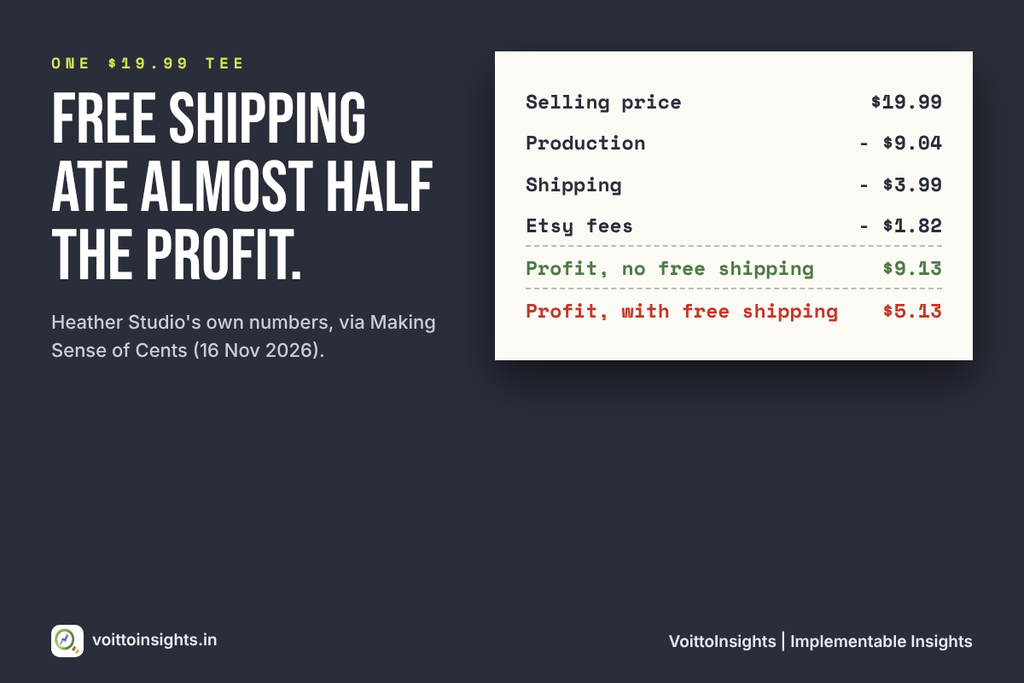
The moment she offered free shipping, almost half the profit on that shirt disappeared.
Read that last line again.
Every “free shipping above 499” banner you’ve seen on an Indian D2C site? Same maths. Someone is paying for that delivery. If it’s not the customer, it’s your margin.
The mental model: Don’t look at revenue. Look at profit per order. Then multiply.
3. The First Twist (Copycats)
Here’s what the “passive income” reels skip.
Her first shop didn’t die from no sales. It died from success.
Other sellers copied her designs. Once you’re visible on a marketplace, you’re visible to competitors too.
So what did she do?
She abandoned that shop, started again, and now keeps her active shops private.
The business lesson: On a marketplace, your designs are public. Your system is not. The real asset is your process for finding niches and making designs fast. Protect that.
4. The Second Twist (She Closed a Winner)
She also ran a Shopify store on the side.
It made roughly $100,000 in gross profit in its first year.
And she shut it down.
Why? Time. A second store on top of 12-hour hospital shifts was too much.
Read that like a founder, not a fan.
Not every profitable thing deserves your hours. Clarity is choosing which money to walk away from.
Not every profitable thing deserves your hours.
5. The Black Friday Trap (Timely Warning)
Black Friday is 27 November. Indian brands now run their own version, plus the end-of-season sales that follow.
So here’s a warning, borrowed from Liz Wilcox, the new owner of Smart Passive Income, on her 4 November podcast episode.
She says Black Friday has earned her close to a million dollars over the years. She’s a fan.
But her red flags are brutally honest:
- ? A deal you can’t actually afford
- ? Thin margins. Her example: a $20 journal at 50% off.
- ? A cold or tiny email list
- ? Heavy competition. Everyone has a sale.
Put the T-shirt receipt next to that list.
A $19.99 shirt with $5 profit. Now take 30% off “for the sale”.
You just paid the customer to wear your design. Paisa Vasool for them. Not for you.
Liz’s fix is simple: package a solution, not a discount. And check the maths before you announce anything.

6. The Receipt Test (10 Minutes, No Tools)
Do this tonight. One product. One sheet of paper or one Google Sheet.
- Write your selling price.
- Subtract the cost to make or buy it.
- Subtract shipping. Even if the customer “doesn’t pay” it.
- Subtract platform fees. Etsy, Amazon, Meesho, Shopify, payment gateway. All of it.
- Subtract your ad cost per order. Ad spend divided by orders.
- Subtract returns. Real Indian e-commerce has COD returns. Count them.
What’s left is your profit per order.
Now ask one question:
Would I do this for that number, 100 times a month?
If yes, scale it.
If no, fix the price, the product or the channel first. Not the ads.
7. Quick Scorecard (Be Brutally Honest)
| Question | ? Healthy | ? Danger |
|---|---|---|
| Do you know your profit per order? | Yes, to the rupee | “Roughly” |
| Does free shipping still leave profit? | Yes | You haven’t checked |
| Is your discount below your margin? | Yes | Discount > margin |
| Can a copycat clone your whole business in a week? | No, the system is yours | Yes, it’s just the design |
| Does the side hustle fit your actual week? | Yes | You’re closing a winner from burnout |
Three or more ?? Don’t spend on ads this week. Spend one evening on the receipt.
The Mental Model
Revenue tells you people want it. Profit tells you if you should keep doing it.
Big numbers get screenshots. Small numbers pay the bills.
FAQs
Is print-on-demand still worth starting in 2026?
It can be. The upside is no inventory. The downside is thin margins and easy copying. Do the receipt test before you design 50 products.
What’s a good profit per order?
There’s no magic number. It needs to cover your ad cost per order, returns and your time, with something left over. If ads cost more than your profit per order, you’re buying revenue, not building a business.
Should I offer free shipping?
Only if you’ve built the shipping cost into the price, or your average order is big enough to absorb it. Run the receipt both ways first.
Should I run a Black Friday sale?
Maybe. Check the maths at the sale price first. If the discount eats the margin, sell a bundle or a bonus instead.
Final Takeaway
Six weeks of zero sales didn’t stop her.
Not knowing her numbers would have.
So:
Write the receipt.
Find your real number.
Then decide.
Clarity first. Ads later.
VoittoInsights | Implementable Insights.
Discover more from Voitto Insights
Subscribe to get the latest posts sent to your email.